One Codebase, Multiple Brand Identities: Build-Time Multi-Tenant Architecture in Next.js
Endure Admin
Software Development
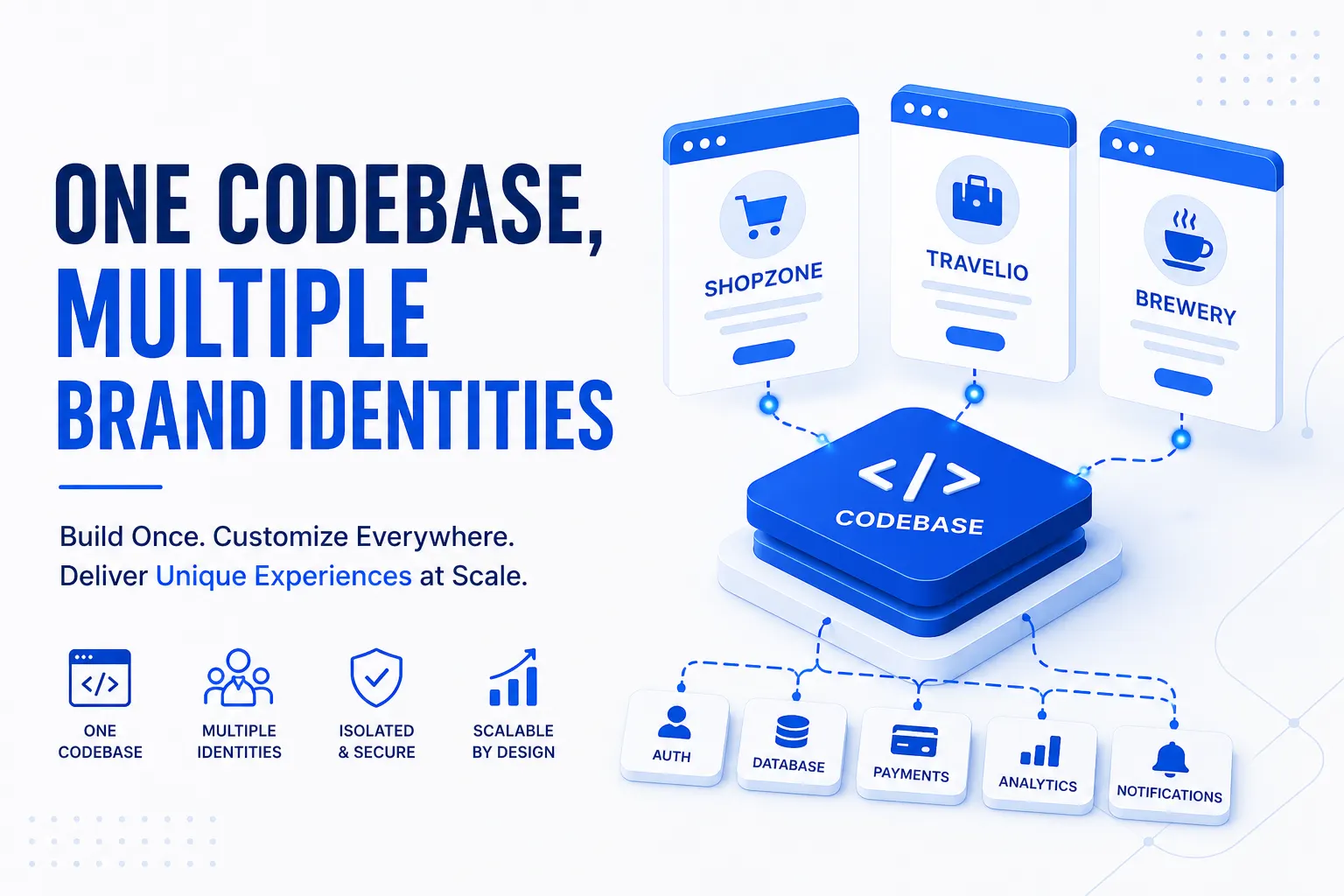
Building an application by duplicating the same infrastructure across multiple brands leads to rising maintenance costs, reduced scalability, and bugs that have to be fixed in every codebase. Let's walk through how a multi-tenant architecture turns a single Next.js codebase into fully isolated, brand-specific apps — without the duplication.
The Problem Every Growing Brand Eventually Hits
Multiple brands with distinct identities are hard to maintain when each has its own look and feel. Take two restaurants under the same ownership: one is a trendy boba shop with bright, youthful aesthetics built around fast turnover and a Gen Z customer base; the other is an intimate pasta bar where the experience is the product.
Both need different menus, different price points, and an entirely different visual language — each with its own branded app. And they're run by a team that has neither the budget for two parallel engineering efforts nor the appetite for the maintenance debt that comes with them.
Why the Standard Approaches Fall Short
Parallel codebases. Running separate repositories for each brand seems like the most straightforward path, but it's expensive. Every bug gets fixed twice; every feature gets built twice. Security patches, dependency upgrades, and performance improvements all double. The operational overhead of maintaining separate codebases scales linearly with every new brand, and by the time a business reaches brand three or four, the engineering burden becomes a genuine constraint on growth.
A single "flexible" app. The other instinct is to build one application that detects the brand at runtime and swaps in the appropriate assets. In theory, it solves the duplication problem. In practice, it produces something that matches neither brand — a generic shell where boba and pasta share the same layout skeleton with different hex codes dropped in. Users notice, even if they can't articulate why.
Brand differentiation is about more than color. The compositional logic of an interface — layouts, typography, UI patterns, and tone — matters just as much. There's a performance dimension too: a runtime-switching app bundles assets for every brand into every deployment, so every customer loading the boba shop is silently downloading pasta-bar data they'll never see.
The Architecture We Landed On: Build-Time Tenancy
Runtime brand resolution decides which brand a visitor sees after deployment. Our approach changes the game: we moved brand resolution from runtime to build time. That meant asking the question "which brand is this?" once, at build time, rather than on every request.
The codebase is structured around a shared core layer — order management, cart logic, payment handling, session management — and a brand configuration layer that lives entirely outside the shared code. When we trigger a build for a brand, the pipeline pulls in that brand's config, assets, and content and produces a fully self-contained deployment. Another brand build does the same with its own configuration. The two outputs have no awareness of each other.
The result: each brand gets a lean, optimized bundle containing only what belongs to it. No dead weight. No identity ambiguity. No compromise on brand integrity.
What "Brand Configuration" Actually Means in Practice
Every brand is defined through a configuration file that governs everything the shared code needs to render correctly for that context. So what actually lives inside one of these files? A handful of things, mostly.
There's the visual layer, obviously — colors, fonts, spacing, and any component-level tweaks that make a button or card feel like it belongs to that brand. Then there's the menu itself: categories, modifiers, and which items are even available, since a boba shop and a pasta bar aren't just selling different food, they're structuring the ordering experience differently too.
Checkout isn't identical either. Payment methods, delivery zones, order types — a quick-turnover boba shop and a sit-down pasta bar don't need the same flow, so that's part of the config as well. Same goes for the smaller stuff people don't think about until it's missing: button copy, confirmation messages, what an error screen actually says. Even SEO metadata — page titles, descriptions, Open Graph images — gets pulled from this same file, brand by brand.
None of this lives as hardcoded logic in the shared codebase. The app just reads whatever config it's handed at build time and renders accordingly. It doesn't contain conditional logic for specific brands — it simply consumes whichever configuration was injected. Adding a new brand is a matter of authoring a new config file, not touching the application layer.
Business Outcomes Worth Quantifying
So what does your business get out of this?
- Reduced time-to-market for new brands: Onboarding a third brand doesn't require a new development engagement. The infrastructure is already built and validated. What remains is configuration and content — work that can happen in weeks rather than months.
- Compounding returns on core improvements: When we improve checkout conversion logic, ship a faster image-loading strategy, or patch a security vulnerability, every brand on the platform benefits from that single change. The value of any core improvement multiplies across the brand count rather than requiring parallel implementation.
- Brand integrity at scale: No brand is forced to compromise its identity to fit a shared template. A boba shop can use a layout composition that reflects its energy while a pasta bar uses one that reflects its deliberateness. These aren't theme variations — they're genuinely different interfaces built from the same production-grade foundation.
A Note on the Trade-offs
Like any architectural decision, build-time tenancy has its constraints. Changes to brand configuration require triggering a new build and deployment — you can't update a menu item and have it reflect instantly without a pipeline trigger. High-frequency content changes are typically handled by integrating a headless CMS that feeds into the config layer and triggers automated builds on publish.
True separation also needs deliberation. Some cross-brand concerns — analytics pipelines, admin tooling, operational dashboards — are better served by a shared runtime system than by duplicated build outputs. The architecture works best when you're precise about which layer belongs where.
The Broader Principle
Multi-brand architecture is ultimately a question of where you place your bets. Betting on runtime flexibility gives you agility at the cost of coherence. Betting on build-time isolation gives you integrity and performance at the cost of some deployment overhead.
For restaurant groups where brand experience is a competitive differentiator, the second bet tends to be the right one. Ultimately, the goal isn't just to make multiple brands technically possible — it's to make each one feel like it was built specifically for the customers it serves. That's the standard we hold ourselves to, and it's what this architecture was designed to protect.