The Modern Enterprise AI Stack: From Data to Decisions and Direct Action
Endure Admin --222
AI / ML
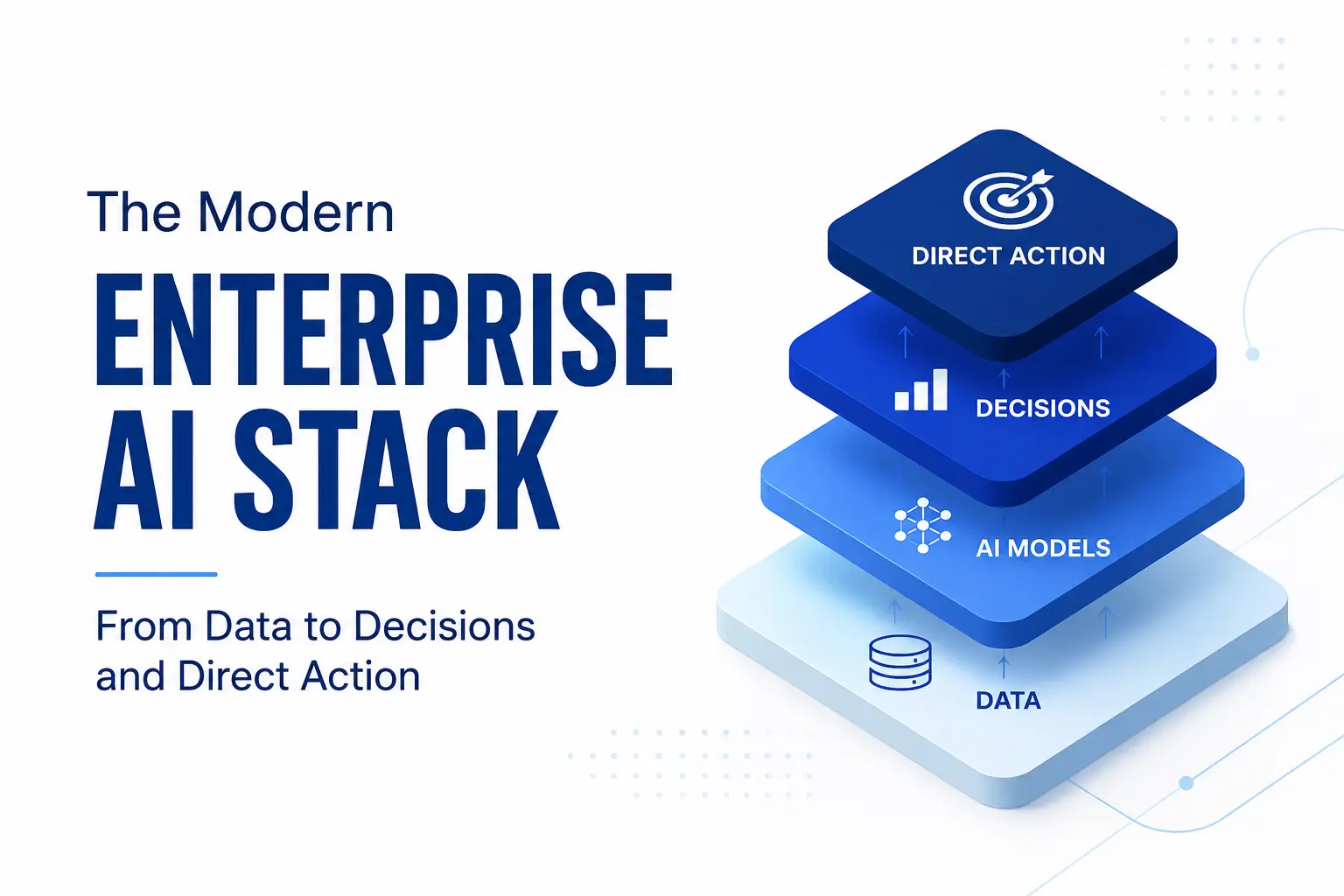
Artificial intelligence has moved far beyond simple chatbots and text generation. Today, organizations expect AI systems to do more than answer questions. They need AI that can access business knowledge, work with existing tools, and support real business processes. But the challenge is no longer whether AI can generate content; it is whether it can produce accurate and trustworthy results in an enterprise environment. hjfdh fjhmnbdn fd,jbdnm
As businesses implement AI at scale, many discover a common problem: demonstrations are good, but turning them into reliable systems is hard. AI may provide incorrect answers, fall short of access to organizational knowledge, or fail to integrate with tools. To address these challenges, modern enterprise AI requires a complete ecosystem rather than a single model. This ecosystem should combine trusted data access, intelligent reasoning, seamless integrations, evaluation, observability, and autonomous execution, and together these components form the modern enterprise AI stack. d,hdsnmṇ dk,hjdbn rj,h hmrdbgk.u
Retrieval Augmented Generation (RAG) ---5555
One of the biggest limitations of traditional AI systems is their dependence on training data. While large language models (LLMs) have a vast amount of general knowledge, they often lack access to an organization's latest documents, policies, product information, and internal processes.
Retrieval Augmented Generation (RAG) addresses this issue by giving AI access to trusted business information, so instead of relying only on what the model learned during training, RAG allows AI systems to search the business knowledge before generating a response. When a user asks a question, the system first retrieves the most relevant information from company documents, databases, or knowledge repositories. The AI then uses this content to generate accurate and informed responses. When AI has access to trusted information, organizations can significantly reduce hallucinations and improve the answer quality. Rather than just guessing the response, the AI uses information already in the business documents.
Knowledge Graphs
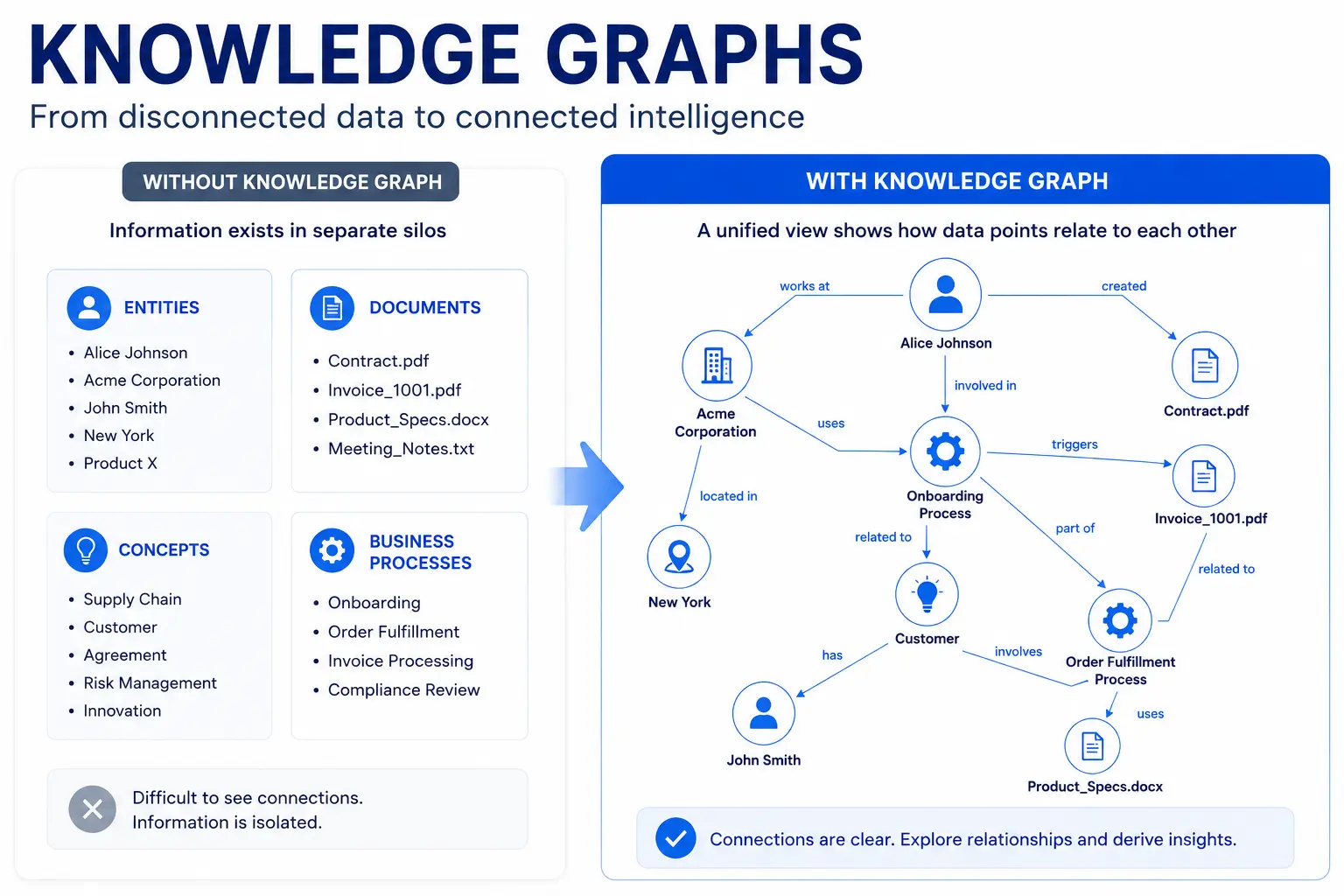
Searching is also important, but understanding relationships between information can have more advantages, as organizations often store the knowledge across multiple systems and repositories. The information is often stored separately across different systems, and users can search for the pieces of information, but understanding how the concepts connect is often very challenging.
Knowledge Graphs solve this issue by creating a structured representation of relationships between entities, concepts, documents, and business processes, so instead of viewing this information as separate pieces, users can explore how the data points relate to one another. Hence, this creates a better understanding of organizational knowledge and enables the AI systems to reason more. Knowledge Graphs also work alongside traditional search systems to improve the results. In many cases, they can find the connections and relationships that the standard keyword-based searches might miss. The result is improved discovery and more intelligent responses.
Model Context Protocol (MCP)
Organizations use a wide range of platforms, including project management systems, communication tools, databases, code repositories, and internal applications. Usually, connecting AI to these systems required custom integrations that were costly and a repetitive task.
The Model Context Protocol (MCP) introduces a standardized approach to this problem. MCP acts as a common standard that allows AI systems to communicate with external tools and data sources, so instead of building custom integrations for every use case, organizations can use a standard framework that allows the AI models to safely access resources and execute actions across different platforms.
This approach reduces development complexity and creates a scalable ecosystem for enterprise AI.
Insights to Actions
Many AI solutions stop at the step of providing information, but users often need more than recommendations; they need the tasks completed. This is where Agent to UI (A2UI) automation becomes important. Rather than just explaining how to navigate an application, AI can interact directly with the user interfaces. It can open dialogs, fill forms, navigate workflows, and guide users through complex processes.
The user remains in control through approval checkpoints, ensuring that the actions are transparent and very secure. This creates a balance between automation and oversight while reducing the effort required to complete those repetitive tasks.
What Matters?
As AI systems become embedded in business operations, organizations must answer an important question: how do we know the AI is performing well?
Without proper evaluation, the teams struggle to compare models, identify quality issues, and optimize performance. Metrics like accuracy, relevance, latency, and cost often vary across the different use cases. AI evaluation and benchmarking platforms provide a planned way to measure performance, which is by comparing the models side by side and tracking the key metrics; hence, the organizations can make informed decisions on which solutions meet their business requirements.
Enterprise AI systems often involve multiple models, workflows, tools, and integrations. When something goes wrong, identifying the root cause can be challenging. This is where AI observability comes in, helping teams understand what is happening at every stage of the AI lifecycle. Teams can trace interactions from prompt to response, monitor system behavior, analyze user feedback, and investigate failures.
Future of Enterprise AI
Over the last few years, we've seen organizations move from experimenting with AI to expecting measurable business outcomes. Achieving that shift requires more than a powerful model; it requires the right data, governance, integrations, and operational visibility. The most successful enterprise AI solutions will not simply generate answers. They will understand context, access the right information, collaborate across systems, execute actions, and continuously improve through measurement and monitoring.
Organizations that implement this modern AI stack will move beyond separate AI experiments and create intelligent systems that are capable of delivering business value at scale. Enterprise AI is no longer just about generating content; it is about building trusted and action-oriented systems that transform how work gets done.